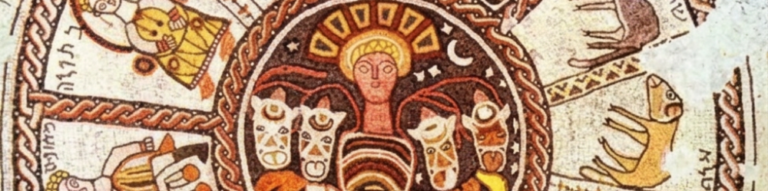
“Nonsense is nonsense, but the history of nonsense is science”. This oft quoted remark was uttered by the eminent scholar, Saul Lieberman in his introduction to Gershom Scholem’s talk about the scientific study of Kabbalah. ‘Nonsense’ being a belief in the existence of the Kabbalah’s unseen upper worlds, of armies of angels, belief in the efficacy of amulets, talismans, etc., and, of course, belief in astrology.
My particular interest in the ‘scientific’ study of Kabbalah revolves around Sefer Yesira and Baraita d’Mazalot. These works, vis-a-vis traditional Halachic Jewish practice, have not much to say in terms of Jewish practice, at least at first glance, they do not.
I have stepped in and out of this shadow of scientific study of Hebrew rabbinical texts for many years as an amateur scholar, reading and translating here, pondering there, and forming an opinion about the truths of Kabbalah, not as an apology for ‘nonsense’, but as the established bedrock of Torah truth and values to live by.
In my opinion, the study of astrological concepts has the potential to unite its students into a collective realization of the truth of the One Deity. That realization powers the awareness of divine supervision of all of creation and it creatures; whatever happens to me or to the world, must elicit the reply ‘Gam zu la’tova’ | גם זו לטובה — ‘this too is for the good’ – for it is the One Deity that brings all about and that is ultimately for the good; it is divine providence — it is subject matter of astrology.
If we pray for a panacea that soothes and remedies the world’s pains, disappointments, and failures that are caused by conflicts and war between individuals and between nations, the miracle cure that brings relief, first to the individual, then to the family, and then to the collective is the spiritual inspiration and enlightenment that comes from the study of the truths of the Hebrew Kabbalah as presented by the great rabbis and kabbalists such as Natanael Ibn Fayumi (1090-1179) in his ‘Garden of Wisdom’ and Yosef Gikatilla (1248-1329) in his ‘Walnut Garden’.